A Bluetooth tag finds things nearby; a GPS tracker shows your car anywhere with coverage. We compare features, limits and running costs.
A Bluetooth tag helps you find things nearby, within a few dozen metres of your smartphone. A GSM/GPS tracker works out its own position from satellites and sends it over the mobile network, so it shows your car or cargo anywhere there is coverage. For cars, machinery and cargo you need a GPS tracker; Bluetooth tags are useful as an add-on to it.
Below we explain how each device works, where it fits and why a Bluetooth tag is not enough to protect a vehicle.
How a Bluetooth tag works
A Bluetooth tag, or BLE beacon, has no GPS receiver and no SIM card. It only broadcasts a weak radio signal. The location is determined by a smartphone that happens to be nearby: yours or, in some systems, a stranger’s phone passing by.
Range is usually tens of metres, less indoors. Walls, a metal car body and crowds of people noticeably weaken the signal.
Some tags use the manufacturer’s network of smartphones. If someone with a compatible phone walks past your bag, an approximate location appears in the app. But that depends on random passers-by, and in a field or a garage block at night there may be none.
Where Bluetooth tags actually help
- Everyday items: keys, wallet, backpack, suitcase.
- Indoor equipment: tools in a workshop, trolleys in a warehouse, devices on a shop floor. Signal strength (RSSI) gives a rough idea of which zone an item is in.
- An add-on to a GPS tracker. The tracker in a truck detects a BLE tag on the trailer or attachment and records exactly what is hitched right now. That is what Teltonika EYE BLE sensors and other additional sensors are for.
Limitations of Bluetooth tags
- Short range.
- Needs a smartphone nearby, otherwise nobody reports the location.
- No full route history, no mileage or stop reports.
- Easy to find and throw away: it is small and not built into the vehicle.
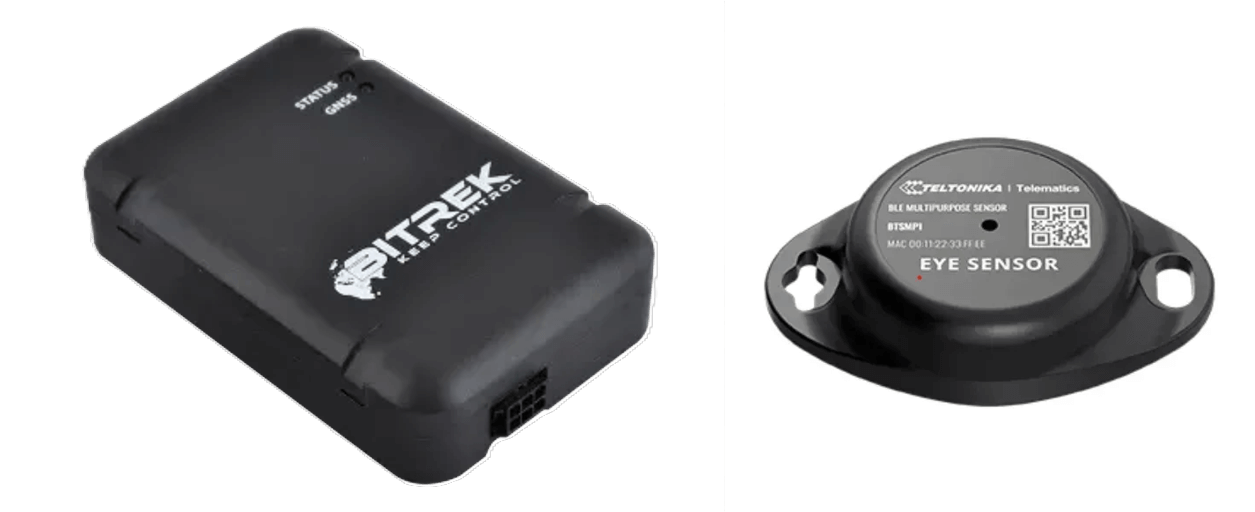
How a GSM/GPS tracker works
A GSM/GPS tracker has a satellite receiver and a GSM modem. It determines its position and sends it to a tracking server such as Wialon or Navi.zone. Distance does not matter: you can be in Kyiv while your van is near Lviv.
What a GPS tracker can do
- Works anywhere there is mobile coverage. Without coverage it stores positions in memory and uploads them when the network is back.
- Locates the vehicle typically to within a few metres in open areas.
- Keeps route history and builds reports on mileage, stops and engine hours.
- Sends alerts on movement, geofence exit or the ignition turning on at night.
- Connects fuel sensors, the CAN bus and the same BLE tags.
Downsides of a GPS tracker
- Costs more than a Bluetooth tag.
- Needs a SIM card and a tracking platform subscription.
- A wired tracker has to be installed. If you want to skip that, there are plug-in trackers for the cigarette lighter socket that start working in a minute.
GPS tracker vs Bluetooth tag: comparison
| Feature | Bluetooth tag | GSM/GPS tracker |
|---|---|---|
| Range | Tens of metres from a smartphone | Unlimited wherever there is mobile coverage |
| Positioning | Via a nearby smartphone | Own satellite receiver |
| Power | Coin battery | Vehicle power or its own battery |
| Route history and reports | None or very limited | Yes |
| Geofences and alerts | Limited | Yes |
| Subscription | Usually none | SIM card and tracking platform |
| Best for | Keys, bags, indoor equipment | Cars, cargo, machinery, fleets |
Why a car needs a GPS tracker
Imagine your pickup disappears overnight. A Bluetooth tag in the glovebox shows only the last place where a compatible phone happened to be nearby. A GPS tracker shows where the pickup is heading right now and alerts you the moment it starts moving.
- Real-time tracking regardless of distance.
- Reliable power. A wired tracker runs off the vehicle, and a battery-powered GPS beacon lasts weeks or years.
- Hidden installation. The tracker is fitted inside the vehicle, out of sight, with no smartphone needed nearby.
- Business value. Mileage, route and fuel reports, control of company cars.
Tracking is affordable: Navi.zone Base from $9.90 per vehicle per year, Wialon Hosting 195 UAH per month or 899 UAH for 6 months.
About people. Use personal trackers for children or elderly relatives with their knowledge (for children, by the parents’ decision). Covertly tracking another person without their consent is illegal in Ukraine (Articles 163 and 182 of the Criminal Code).
FAQ
Can a Bluetooth tag protect a car from theft?
Only as a backup. A tag shows a location only when a compatible smartphone happens to be nearby, and it does not raise an alarm when the car is stolen. To protect a car you need a GPS tracker, ideally plus a separately hidden battery beacon that keeps working if the main device is disabled.
Does a GPS tracker work without internet?
The tracker determines its position without internet, using satellite signals. But it sends that position to the server over the mobile network, so it needs a SIM card with data. If coverage drops for a while, the tracker stores positions in memory and uploads them as soon as the network returns.
How much does GPS tracking cost per month?
The running cost has two parts: the SIM card and the tracking platform. Navi.zone Base starts from $9.90 per vehicle per year, and Navi.zone Pro is 2,248 UAH per year for a package of up to three vehicles. Wialon Hosting is 195 UAH per month or 899 UAH for six months.
Can I combine a GPS tracker with Bluetooth tags?
Yes, and it is handy for business. A GPS tracker in a truck or tractor reads BLE tags on the trailer, an attachment or a driver ID card. Reports then show exactly which trailer travelled with the vehicle and who was driving. The combination does not replace the tracker; it extends what the tracker can do.
Read also: How battery-powered GPS beacons work: a complete guide
GPSka · turnkey fleet tracking
A GPS tracker for your car instead of a Bluetooth tag
Tracker, SIM card, setup and dashboard. Navi.zone from $9.90 per vehicle per year, Wialon from 195 UAH per month.