What a CAN bus in a car is, where to find it and how to test it with a multimeter or oscilloscope: resistance, voltage and common faults.
A CAN bus is the digital network the electronic units in a car use to share data: the engine, gearbox, ABS, airbags and instrument cluster. Physically, it is two twisted wires called CAN High and CAN Low. The simplest test uses a multimeter: with the bus powered down, the resistance between CAN-H and CAN-L should be about 60 ohms.
What is a CAN bus in a car?
Bosch developed the Controller Area Network in the 1980s specifically for cars. Instead of a separate wire for every signal, all units share one pair of wires and take turns sending short messages. Each message has an identifier and a priority, so critical data, such as from the brakes, goes first.
For example, you press the brake pedal. The ABS unit sends a message on the bus, and the engine unit, stability control, brake lights and instrument cluster all receive it at the same time.
Why a car needs a CAN bus
- Fewer wires.The harness is lighter and cheaper, with fewer places where something can chafe through.
- One sensor for many units.The wheel speed signal, for example, is used by the speedometer, the ABS and the engine unit.
- Diagnostics from one port.A scanner plugged into the OBD II port sees the fault codes of all units.
- Data for add-on equipment.A GPS tracker can read fuel level, mileage and engine speed from the bus without touching the factory sensors.
For fleet tracking, the last point matters most. A long-haul driver refuels, and the dashboard shows both the refuel and the fuel use afterwards, without a separate sensor in the tank. That is what CAN bus readers are for. Keep in mind that the factory fuel gauge is less accurate than a dedicated fuel level sensor, so strict fleet fuel monitoring often uses both.
What a CAN bus looks like
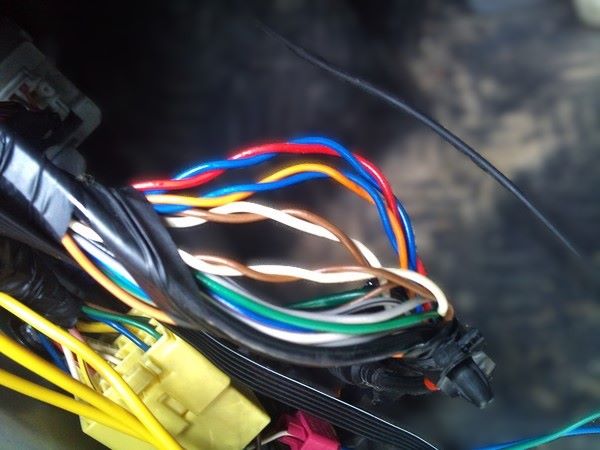
It is a pair of wires twisted together inside the main harness. The twisting reduces interference from ignition coils, the starter and other heavy loads. Wire colours differ between manufacturers, so always check the wiring diagram for your model.
A modern car usually has several CAN buses: a fast one for the engine and transmission and a slower one for comfort features such as windows, climate control and infotainment. They are linked through a central unit, or gateway.
How a CAN bus works
The signal is differential: a unit changes the voltage on both wires at the same time in opposite directions, and the receiver reads the difference between them. Interference affects both wires equally, so it barely changes the difference.
On a high-speed CAN bus to ISO 11898-2, both wires sit at about 2.5 V at rest. When a unit sends an active bit, CAN-H rises to about 3.5 V and CAN-L drops to about 1.5 V. Each end of the bus has a 120-ohm termination resistor.
Where to find the CAN bus
The bus runs through the whole car, but the easiest access point is the OBD II diagnostic port under the dashboard on the driver's side. Under the SAE J1962 standard, pin 6 is CAN-H and pin 14 is CAN-L. You can also find the bus near the engine unit, the instrument cluster and the body control module. The exact location depends on the make and model.
CAN bus pinout
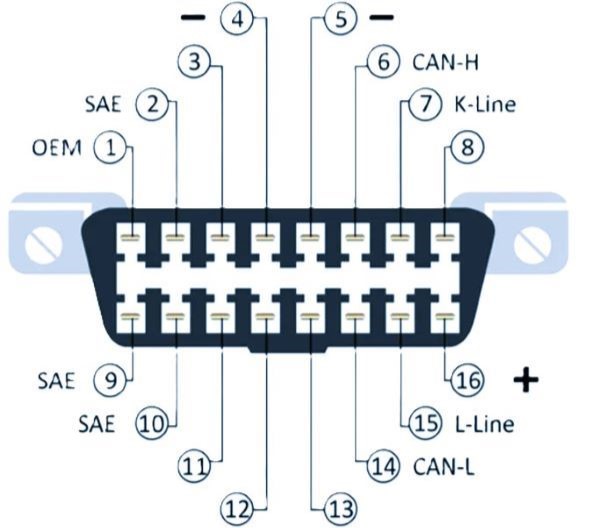
The pinout shows which wire goes to which connector pin. In the OBD II port, besides CAN-H and CAN-L on pins 6 and 14, there is ground on pins 4 and 5 and +12 V on pin 16. Installers use the wiring diagram for the specific car when connecting a tracker or reader, because a mistake can trigger warnings on the dashboard.
Common CAN bus faults
- A broken CAN-H or CAN-L wire.
- A short between CAN-H and CAN-L, to ground or to +12 V.
- Corroded or damp connector contacts.
- A faulty unit flooding the bus with junk messages.
- Poorly installed add-on equipment: an alarm, a head unit, a tracker.
Symptoms include several warning lights at once, gauges dropping to zero, a car that won't start, and a diagnostic scanner showing communication errors with units (U-codes).
How to test a CAN bus with a multimeter
- Switch off the ignition, disconnect the negative battery terminal and wait a few minutes for the units to go to sleep. Resistance is only measured on a powered-down bus.
- Find CAN-H and CAN-L, for example pins 6 and 14 of the OBD II port.
- Measure the resistance between them.
- Compare the result with the table.
| Resistance between CAN-H and CAN-L | What it means |
|---|---|
| About 60 ohms | Normal: both terminators are in place and the bus is intact |
| About 120 ohms | One terminator is disconnected, or the bus is broken between the test point and one end |
| Close to 0 ohms | Short circuit between CAN-H and CAN-L |
| Very high, meter shows open circuit | Both terminators disconnected or a break in both directions |
To locate a break, measure the resistance of one wire, for example CAN-L, between two units. A good wire reads close to 0 ohms, and high resistance means a break in that section. Then check CAN-H the same way.
Checking the voltage
Reconnect the battery and switch on the ignition. A multimeter set to DC volts against ground will usually show slightly above 2.5 V on CAN-H and slightly below 2.5 V on CAN-L. If one wire reads 0 V or 12 V, look for a short to ground or to positive.
Checking with an oscilloscope
An oscilloscope shows the signal shape: square pulses going up from 2.5 V on CAN-H and mirror-image pulses going down on CAN-L. Rounded edges, noise or steps point to a poor contact, a termination problem or interference. A low-speed fault-tolerant CAN bus uses different levels, so follow the carmaker's documentation for it.
CAN bus and GPS trackers
A tracker reads CAN data in one of two ways: through a contactless reader clipped onto the wire without breaking the insulation, or through a direct connection to CAN-H and CAN-L. Some trackers, such as the Teltonika FMB140, have a built-in CAN data processor; others use an adapter like the Teltonika LV-CAN200 CAN adapter. The available data depends on the vehicle model, so compatibility is checked before installation.
FAQ
Can I test a CAN bus with an ordinary multimeter?
Yes, a multimeter is enough for a basic check. Use it to measure the resistance between CAN-H and CAN-L on a powered-down bus and the voltage on each wire with the ignition on. It will reveal a break, a short or a missing terminator, but only an oscilloscope shows the signal shape and interference.
What should the CAN bus resistance be?
On a healthy high-speed CAN bus, the resistance between CAN-H and CAN-L is about 60 ohms. That is two 120-ohm terminators connected in parallel. About 120 ohms means one terminator is disconnected or there is a break, while almost zero means a short circuit between the wires.
Is it safe to connect a GPS tracker to the CAN bus?
Yes, if it is connected correctly. A contactless reader only listens to the bus and doesn't interfere with it, so it is the safest option for newer cars. A direct connection is best left to installers with the wiring diagram for your model, because a mistake can disrupt the units and trigger dashboard warnings.
What data does a GPS tracker get from the CAN bus?
Most often it is the fuel level from the factory sensor, odometer mileage, engine speed and temperature, fuel consumption and pedal status. Trucks and farm machinery usually provide more data. The exact list depends on the make and model, so check the vehicle against the compatibility list before installation.
Read also: how to check a fuel level sensor: a complete guide
GPSka · turnkey fleet tracking
Fuel and mileage from the CAN bus in your dashboard
Tracker, SIM card, setup and dashboard. Navi.zone from $9.90 per vehicle per year, Wialon from 195 UAH per month.